top of page

A Note to Our Readers: Our health blog sometimes features articles from third-party contributors. We share ideas and inspiration to guide your wellness journey—but remember, it’s not medical advice. If you have any health concerns or ongoing conditions, always consult your physician first before starting any new treatment, supplement, or lifestyle change.

Returning to Sport After a Car Accident: A Complete Guide for Athletes

  • Writer: Monica Pineider
    Monica Pineider
  • 11 hours ago
  • 9 min read

Medically Reviewed by the Clinical Team at Arrowhead Clinic: Licensed Doctors of Chiropractic specialising in musculoskeletal injuries, rehabilitation and post-accident care. Arrowhead Clinic has provided chiropractic care for accident victims for more than 48 years and offers same-day evaluations for patients recovering from motor vehicle injuries.


This article is intended for educational purposes only and should not replace personalised medical advice or assessment from a qualified healthcare professional.


Athlete undergoing rehabilitation before returning to sport after a car accident.

Quick Answer


Returning to sport after a car accident involves more than simply waiting for pain to settle.

Although medical clearance confirms that injuries are stable enough for everyday activities, athletes often need additional rehabilitation to restore strength, mobility, coordination and confidence before safely returning to training or competition.


A structured rehabilitation programme can help reduce the risk of re-injury while supporting long-term performance.


Key Takeaways


✔ Medical clearance does not always mean you are ready to return to sport.

✔ Car accidents can affect movement patterns long after pain improves.

✔ Progressive rehabilitation helps rebuild strength, mobility and confidence.

✔ Returning too quickly may increase the risk of compensatory injuries.

✔ Exercise-based rehabilitation, supported by appropriate healthcare professionals, offers the safest path back to training.


Table of Contents


Returning to Sport Takes More Than Medical Clearance


Being discharged from hospital or told you are "fit to resume normal activities" can feel reassuring after a car accident. However, for athletes and physically active adults, medical clearance is often only the first milestone—not the finish line.


Everyday activities such as walking, driving or working place very different demands on the body compared with running a marathon, lifting heavy weights or competing on the tennis court. Even when pain has improved, subtle changes in strength, balance, coordination and movement quality may still be present.


Returning to high-intensity exercise before these issues have been addressed can increase the risk of recurrent pain, reduced performance and secondary injuries.


The goal is not simply to become pain-free.


The goal is to move confidently, efficiently and safely under the physical demands of your chosen activity.


Returning too soon may increase injury risk. Exercise medicine research consistently shows that athletes recovering from musculoskeletal injuries benefit from progressive, exercise-based rehabilitation rather than relying on pain reduction alone. Gradually restoring strength, mobility and neuromuscular control helps reduce the likelihood of compensatory movement patterns that may contribute to future injuries.


Common Injuries Athletes Experience After a Collision


Motor vehicle collisions expose the body to rapid acceleration and deceleration forces that can affect muscles, joints, ligaments and connective tissues.


Some injuries are immediately obvious, while others become noticeable only when you return to training.


The most common include:


Whiplash


Whiplash involves rapid movement of the neck beyond its normal range.


Although often associated with neck pain, athletes may also experience:


  • Reduced shoulder mobility

  • Headaches during exercise

  • Difficulty rotating the neck

  • Muscle guarding

  • Reduced upper-body strength


For sports requiring overhead movement or rapid changes in direction, even mild whiplash can significantly affect performance.


Shoulder Injuries


Seatbelts and airbags frequently transfer force through the shoulder.


Common problems include:


  • Rotator cuff irritation

  • Shoulder instability

  • Reduced overhead movement

  • AC joint sprains

  • Muscle weakness


Athletes involved in swimming, tennis, CrossFit and weightlifting often notice these limitations during overhead exercises, reduced shoulder strength, or decreased performance before they experience pain in everyday life.


Lower Back and Pelvic Injuries


The sudden deceleration of a collision places considerable stress on the lumbar spine and pelvis.


Symptoms may include:


  • Low back pain

  • Hip stiffness

  • Reduced glute activation

  • Sacroiliac joint irritation

  • Limited hip mobility


For runners, cyclists and lifters, these changes often alter movement efficiency long before obvious pain develops.


Lower Limb Injuries


Ankle, knee and hip injuries frequently create compensation patterns.


For example, favouring one leg during recovery may increase stress on the opposite side, contributing to:


Identifying these movement changes early helps reduce the likelihood of secondary injuries.


⭐ Clinical Insight


Pain is not always the best measure of recovery. Many athletes regain strength before they regain movement quality. They may feel capable of returning to training while still unconsciously shifting weight, limiting joint movement or changing their technique to protect an injured area.


These subtle compensations often become the source of future injuries if they are not addressed during rehabilitation.


Why Progressive Rehabilitation Matters


Recovery should not focus solely on healing injured tissues.


It should also restore the way your body moves.


Progressive rehabilitation aims to rebuild:


  • Joint mobility

  • Muscle strength

  • Balance

  • Coordination

  • Proprioception

  • Sport-specific movement patterns


Rather than immediately returning to previous training loads, exercises are gradually progressed according to your symptoms, movement quality and functional goals.


For many athletes, this stage determines whether they return stronger—or continue struggling with recurring setbacks.


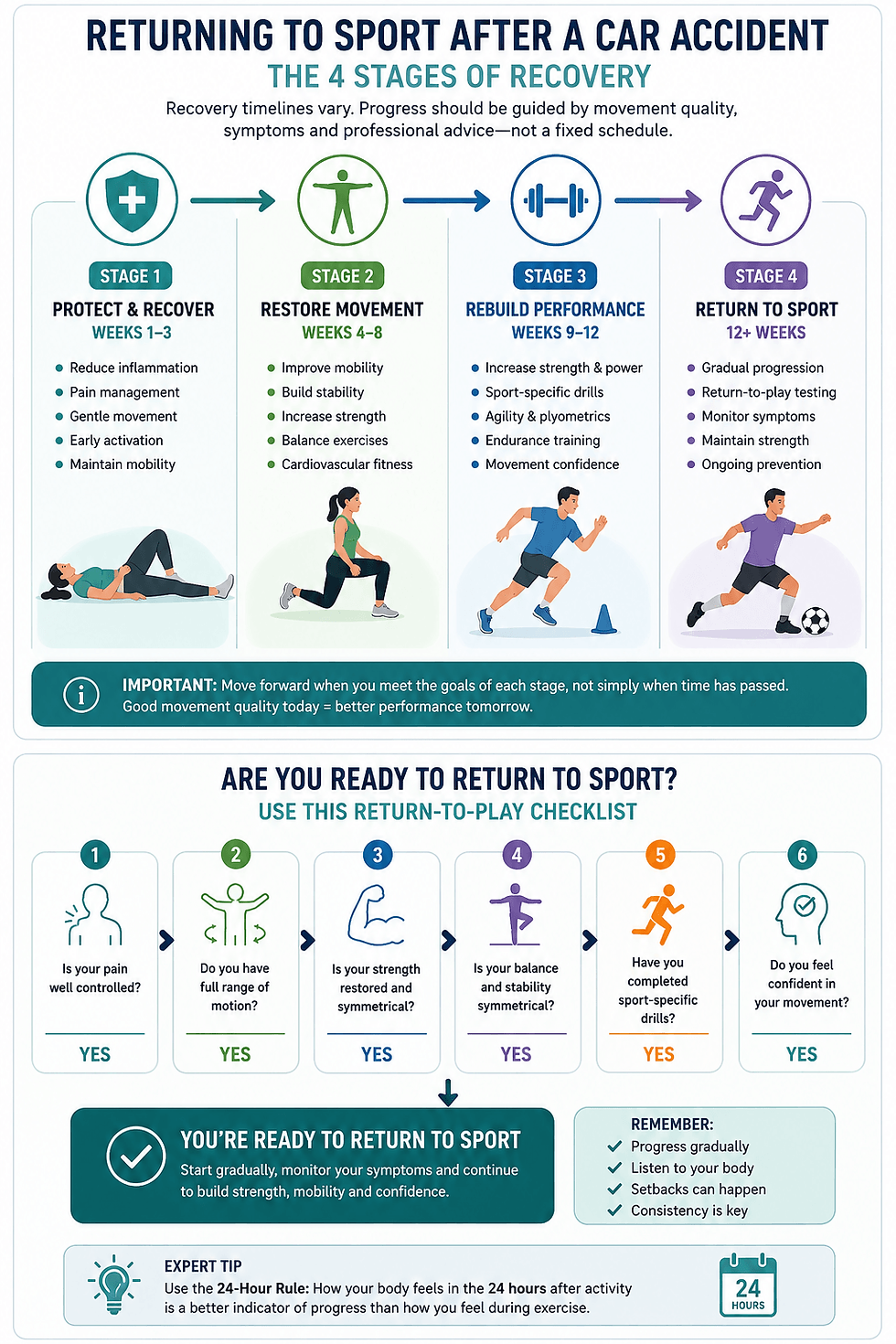
Infographic on returning to sport after a car accident, showing 4 recovery stages, a checklist, and athletes exercising.
Recovery timelines vary between individuals. Progress should always be guided by movement quality and professional advice rather than a fixed schedule.

Your Recovery Timeline: What to Expect


Every recovery is different. The type of collision, the severity of your injuries, your fitness level and any previous musculoskeletal problems all influence how quickly you return to sport.


Rather than focusing on an exact date, rehabilitation should be guided by your symptoms, movement quality and functional progress.


Weeks 1–3: Protect and Restore


The first few weeks focus on reducing pain and inflammation while preventing unnecessary deconditioning.


Depending on your injuries, your rehabilitation programme may include:


  • Gentle range-of-motion exercises

  • Walking

  • Breathing exercises

  • Light mobility work

  • Pain management strategies

  • Early activation of stabilising muscles


Complete bed rest is rarely recommended unless medically necessary. Research shows that prolonged inactivity can contribute to muscle weakness, joint stiffness and slower functional recovery.


The goal during this stage is to keep the body moving safely while allowing injured tissues to heal.


Weeks 4–8: Rebuild Strength and Movement


As pain improves, rehabilitation becomes more active.


Treatment often progresses to:


  • Core stability exercises

  • Resistance band work

  • Bodyweight strength training

  • Balance exercises

  • Functional movement patterns

  • Cardiovascular conditioning


Rather than chasing heavy weights or long runs, athletes should concentrate on restoring good movement mechanics.


This is often the stage where hidden compensations become more obvious.


Weeks 9–12: Return to Performance


Once strength and mobility have improved, rehabilitation becomes increasingly specific to your sport.


Examples include:


  • Running drills

  • Agility work

  • Plyometric exercises

  • Progressive resistance training

  • Throwing mechanics

  • Sport-specific endurance


The aim is to prepare your body for the demands of competition rather than simply everyday movement.


Returning gradually also allows your healthcare team to identify any remaining weaknesses before they develop into new injuries.


Movement quality matters as much as strength. Research in sports medicine consistently demonstrates that successful return-to-sport programmes assess not only pain and strength, but also balance, coordination, movement symmetry and confidence during functional tasks. These factors are associated with a lower risk of recurrent injury following musculoskeletal rehabilitation.

Returning to Training Safely


One of the biggest mistakes athletes make is trying to return to their previous training volume too quickly.


Although motivation is important, your body needs time to adapt.


Before increasing intensity, ask yourself:


  • Can I move without compensating?

  • Is my strength similar on both sides?

  • Can I complete a training session without symptoms worsening afterwards?

  • Have I regained confidence in my movement?


If the answer is no, reducing training intensity temporarily is often the safest approach.


Many sports medicine professionals recommend increasing training volume gradually while monitoring how your body responds over the following 24 to 48 hours.


⭐ Clinical Insight


A useful guideline is to focus on movement quality before performance. Running faster, lifting heavier or training longer should come after you can move confidently with good technique.


Athletes who prioritise movement quality often recover more efficiently and reduce their risk of future injuries.


Can Complementary Therapies Support Recovery?


Exercise-based rehabilitation remains the foundation of recovery following a collision.

However, depending on your injuries and stage of rehabilitation, some people choose to include complementary therapies as part of a broader recovery plan.


Manual therapies may help address muscle tension, improve comfort and support mobility alongside an appropriate rehabilitation programme.


For example:


  • Sports Massage may help reduce muscle tightness and support recovery after returning to training.

  • Deep Tissue Massage can be useful for addressing persistent muscular tension that develops through protective movement patterns.

  • Dry Needling is used by some people as part of a multidisciplinary approach to help manage musculoskeletal pain and support rehabilitation.


These therapies should complement—not replace—medical assessment, physiotherapy and progressive exercise.


Treatment should always be tailored to your individual injuries, goals and stage of recovery.


Red Flags That Shouldn't Be Ignored


While some muscle soreness is expected during rehabilitation, certain symptoms require further medical assessment.


Speak to your healthcare provider if you experience:


  • Increasing rather than improving pain

  • Persistent numbness or tingling

  • Progressive weakness

  • Loss of balance

  • Joint locking or instability

  • Pain that prevents normal daily activities

  • Symptoms that worsen significantly after exercise


These signs may indicate injuries that require additional investigation before returning to sport.


When Should You Seek Professional Help?


Although many people gradually improve with a structured rehabilitation programme, new or worsening symptoms should never be ignored. Early assessment can help identify movement restrictions, joint dysfunction or compensatory patterns before they develop into longer-term problems.


When pain spikes suddenly, when range of motion drops overnight, or when you need a movement assessment before a key training session, finding a walk in chiropractor near me can mean the difference between a minor setback and a multi-week regression. Prompt assessment allows appropriate treatment or referral, helping athletes stay on track with their rehabilitation goals.


Building Your Recovery Team


Returning to sport after a collision is rarely achieved through one treatment alone.


Many athletes benefit from a multidisciplinary approach that may include:


  • Sports medicine physicians

  • Physiotherapists

  • Strength and conditioning professionals

  • Massage therapists

  • Acupuncturists

  • Personal trainers with rehabilitation experience


Good communication between healthcare professionals helps ensure that rehabilitation progresses safely while supporting your long-term performance goals.


Remember, your objective is not simply to recover from the accident—it is to return to the activities you enjoy with confidence.


Practical Considerations During Recovery


Recovering from a serious collision often involves more than physical rehabilitation. Medical expenses can increase while time away from work or sport affects income, adding financial pressure during recovery.


If your injuries resulted from a collision involving a commercial vehicle, seeking advice from an experienced truck accident lawyer Atlanta early may help protect your compensation claim and ensure ongoing rehabilitation costs—such as physiotherapy, imaging, specialist consultations and other medically necessary care—are properly considered. Addressing these issues early can allow you to focus on your recovery without unnecessary financial uncertainty.


Continue Your Recovery Journey


Recovering from an injury often involves more than waiting for pain to settle. Our Exercise & Rehabilitation Hub brings together evidence-informed articles on sports injuries, rehabilitation, mobility, recovery strategies and complementary therapies to help you move with confidence. You'll also find practical guides on Sports Massage, Deep Tissue Massage and Acupuncture, explaining how these therapies may complement an individualised rehabilitation programme when appropriate.


Frequently Asked Questions


How soon can I return to sport after a car accident?


Recovery varies depending on the severity of your injuries and the demands of your sport. Medical clearance is only one milestone; many athletes benefit from additional rehabilitation before returning to full training.


Can I exercise if I still have some pain?


Mild discomfort during rehabilitation may be normal, but increasing pain, significant swelling or worsening symptoms should be assessed by a healthcare professional before continuing.


Is physiotherapy enough on its own?


Physiotherapy forms the foundation of many rehabilitation programmes. Depending on your individual needs, some people also include complementary therapies such as sports massage or acupuncture as part of a multidisciplinary approach.


Why do I feel weak even though my injury has healed?


After an injury, muscles and the nervous system may temporarily lose strength, coordination

and confidence. Progressive rehabilitation helps restore these functions before returning to higher levels of activity.


What is the biggest mistake athletes make after a collision?


Returning to training too quickly. Even if pain has improved, movement quality, strength and balance may not have fully recovered.


Final Thoughts


Returning to sport after a car accident is about far more than waiting for pain to disappear.


A successful recovery involves rebuilding strength, restoring movement quality and gradually preparing your body for the physical demands of training and competition.


Taking the time to follow a structured rehabilitation programme, listening to your body and working with qualified healthcare professionals can reduce the risk of re-injury and help you return with greater confidence.


For many athletes, recovery also provides an opportunity to improve movement patterns, address previous weaknesses and build a stronger foundation for future performance.


References


  1. Viderman D, et al. Impact of Exercise Therapy on Outcomes in Patients with Low Back Pain: An Umbrella Review. Journal of Clinical Medicine. 2025. Available at: https://pmc.ncbi.nlm.nih.gov/articles/PMC12429691/ 

  2. Rehabilitation and Return to Sport of Female Athletes. Sports Health. Available at: https://pmc.ncbi.nlm.nih.gov/articles/PMC11818561/

  3. Return to Sport Following Injury: Current Concepts and Rehabilitation Strategies. Sports Medicine and Health Science. Available at: https://www.sciencedirect.com/science/article/pii/S2666061X21002571

  4. Rehabilitation Science: Why Physiotherapy Is Central to Modern Healthcare Recovery. Manipal University Malaysia. Available at: https://manipal.edu.my/rehabilitation-science-why-physiotherapy-is-central-to-modern-healthcare-recovery/


Author


A to Z Therapies Editorial Team

The A to Z Therapies Editorial Team creates evidence-informed health content to help readers make informed decisions about their wellbeing. Every article is researched using current clinical guidance and peer-reviewed evidence, reviewed for accuracy, and published in line with the A to Z Therapies Editorial Policy, which prioritises Experience, Expertise, Authoritativeness and Trustworthiness (E-E-A-T).

Recent Posts

About the Author


Monica Pineider is the author of the A to Zen Therapies health blog and founder of a Central London wellness clinic. She specialises in massage therapy and holistic treatments, drawing on professional experience since 2009 in reflexology, shiatsu, and deep tissue massage.


She trained in Thailand and Bali in traditional massage techniques before continuing advanced hands-on study in London across multiple therapy disciplines. This international and clinical background has shaped the approach and philosophy of A to Zen Therapies.


Monica oversees the editorial direction of every article published on the blog, including content written or contributed to by external specialists in areas beyond the clinic’s direct clinical experience. All content is reviewed to ensure clarity, accuracy, and alignment with our editorial standards.


She shares practical, experience-based insights to support relaxation, recovery, and everyday wellbeing.

⚠️ Medical Disclaimer


The information provided on this website is for educational and informational purposes only and is not intended as medical advice, diagnosis, or treatment.


Always seek the advice of your physician, qualified healthcare provider, or other licensed medical professional regarding any medical condition, symptoms, or treatment options. Do not disregard professional medical advice or delay seeking it because of information you have read on this website.


A to Zen Therapies and its contributors provide information for general informational purposes only and may not reflect individual medical circumstances. Individual results from wellness practices, supplements, or natural therapies may vary.


If you are pregnant, nursing, taking medication, or have a pre-existing health condition, consult a qualified healthcare professional before starting any new wellness routine, supplement, or therapy.


Use of this website and its content is at your own risk.

Editorial Note

This article has been reviewed in accordance with A to Zen Therapies’ Editorial Policy to ensure accuracy, clarity, and responsible, experience-based wellness information.

bottom of page