top of page

A Note to Our Readers: Our health blog sometimes features articles from third-party contributors. We share ideas and inspiration to guide your wellness journey—but remember, it’s not medical advice. If you have any health concerns or ongoing conditions, always consult your physician first before starting any new treatment, supplement, or lifestyle change.

Data Governance Consultants for Healthcare and Wellness Organisations

Writer: Monica Pineider
Monica Pineider
Sep 15
10 min read

Updated: Sep 30

Healthcare and wellness organisations collect more sensitive information than many small businesses realise. Consultation forms, treatment notes, health histories, appointment records, invoices, telehealth messages and marketing preferences may all reveal something about a person’s health.


This makes data governance more than an IT project. It affects patient confidentiality, clinical safety, staff accountability and trust.


The Information Commissioner’s Office explains that health information receives additional protection as special-category data under the UK GDPR. In some circumstances, even appointments or invoices may reveal health information—for example, a series of physiotherapy bookings or visits to a specialist clinic. ICO guidance therefore provides an important starting point for UK organisations.


Larger clinics, health technology businesses and multisite providers may need specialist support to identify where information is stored, control access and establish consistent rules across different systems. This guide compares five data governance consulting companies that may be worth investigating.


Quick Answer


A healthcare data governance consultant helps an organisation decide what information it collects, why it is needed, where it is stored, who may access it, how long it should be retained and when it must be deleted.


The right provider depends on the organisation’s size and technical environment. A small independent therapy clinic may need a focused privacy and records review, while a hospital group or digital health platform may require data cataloguing, system integration, cloud governance and automated access controls.


Key Takeaways


  • Health information requires greater protection than ordinary business data.

  • Data governance covers people, policies and accountability—not only software.

  • A consultant cannot assume an organisation’s legal responsibility for patient information.

  • Healthcare experience should be verified through relevant case studies and references.

  • UK organisations should assess UK GDPR requirements, while access to NHS systems may introduce additional obligations.

  • AI, telehealth and automated messaging require clear rules governing data access and human oversight.

  • Start with a data inventory and risk assessment before purchasing a governance platform.


Table of Contents


Why Data Governance Matters in Healthcare


A wellness clinic may use one platform for bookings, another for consultation forms, separate software for payments and ordinary email or messaging tools for follow-up communication. Information can quickly become duplicated across staff inboxes,

spreadsheets, cloud folders and third-party systems.


Without clear governance, an organisation may struggle to answer basic questions:


  • What patient information do we hold?

  • Why was it collected?

  • Which employees and contractors can see it?

  • Is it being used for its original purpose?

  • Which external providers receive it?

  • How long will it be retained?

  • How can a patient request access or correction?

  • What happens when a practitioner leaves?

  • How would we respond to a breach?


These questions are relevant to physiotherapy, acupuncture, massage, fertility support, mental healthcare, private diagnostics, telehealth and other health-related services.


They also connect with the responsible use of emerging technology. A to Zen Therapies’ guide to ethical AI messaging for wellness clinics explains why administrative, clinical and promotional communications should have separate purposes, permissions and safeguards.


Evidence and Governance Snapshot


Area

Responsible approach

Consultation records

Limit access to people who need the information for their role

Appointment reminders

Avoid revealing unnecessary treatment or health details

Marketing

Keep promotional permissions separate from care-related communication

Telehealth

Confirm encryption, access controls, recording practices and storage locations

AI tools

Do not enter identifiable health information without an approved purpose and safeguards

Former employees

Remove system access promptly

Record retention

Establish documented periods rather than retaining everything indefinitely

Patient requests

Maintain a process for access, correction and other applicable rights

Security incidents

Define reporting, containment and notification responsibilities


The ICO identifies seven central data-protection principles: lawfulness, fairness and transparency; purpose limitation; data minimisation; accuracy; storage limitation; security; and accountability. These principles should shape the governance programme rather than appearing only in a privacy policy. Read the ICO’s data-protection principles.


What a Healthcare Governance Programme Should Cover


A useful programme should connect policy with everyday clinical and administrative work.


Data inventory and classification


The organisation should know which systems contain patient, employee, financial, clinical and marketing information. Records should be classified according to their sensitivity and purpose.


Ownership and accountability


Each important dataset should have an owner. That person does not necessarily manage the technology, but should understand why the information exists and who is authorised to use it.


Role-based access


A receptionist may require access to appointment information without needing complete clinical notes. The same principle applies when working with a bilingual virtual medical assistant: system access should be limited to the administrative information required for the assigned role. A marketing contractor should not automatically receive access to consultation forms. Access should reflect responsibilities rather than convenience.


Retention and deletion


Records should not be kept indefinitely merely because storage is inexpensive. Retention periods must account for legal, contractual, clinical, insurance and professional requirements.


Data quality


Incorrect contact details, duplicated patient profiles or outdated medication information can create operational and clinical risks. Governance should define how records are checked, corrected and reconciled.


Third-party oversight


Booking platforms, payment processors, cloud providers, telehealth services and AI vendors may process information on the clinic’s behalf. Contracts should explain permitted uses, security responsibilities, subcontractors, breach notification and what happens to the information when the agreement ends.


AI and analytics controls


Before using patient information for automated analysis, personalisation or model training, an organisation should establish whether the processing is lawful, necessary and proportionate. Human oversight remains essential when technology could influence patient care or access.


Expert tip: Begin with a map of the information you already hold. Buying a sophisticated governance platform before identifying the organisation’s purposes, risks and responsibilities may simply automate an unclear process.


How These Companies Were Selected


This is a non-exhaustive shortlist rather than an independently tested ranking. The providers were included because their public materials describe services involving data governance, data management, cloud platforms, compliance or related engineering.


We considered:


  • Breadth of governance and data-management services

  • Experience described in regulated industries

  • Ability to connect governance with technical implementation

  • Compatibility with common enterprise platforms

  • Availability of published frameworks or case studies

  • Potential relevance to healthcare and digital health organisations


All service descriptions and performance claims should be confirmed directly with the provider.


Five Data Governance Consulting Companies to Compare


Company

Potentially suitable for

Important point to verify

N-iX

Large data, cloud and AI transformation programmes

Directly relevant healthcare governance experience

ScienceSoft

Organisations modernising complex or legacy data systems

Scope of UK healthcare regulatory expertise

Adastra

Enterprises building governance structures from the beginning

Healthcare-specific implementation references

Kanerika

Microsoft-based organisations considering Purview

Licensing, integration and long-term support costs

Ciklum

Digital health products and data-intensive software platforms

Depth of dedicated governance consulting services


1. N-iX


Data governance and cloud engineering services presented by N-iX.
N-iX positions governance within a wider data, cloud, analytics and AI engineering service.

N-iX may be relevant to larger healthcare organisations that need technical implementation alongside policy development. Its public service materials describe data quality, risk management, access allocation, regulatory compliance and governance for cloud-based environments.


The company states that it works across healthcare and other regulated sectors and has more than 300 data governance consultants and engineers. It also describes partnerships involving major cloud platforms and services covering data lakes, warehouses, analytics and AI.


Organisations comparing data governance consulting companies may therefore consider N-iX when governance forms part of a broader cloud migration, data-platform modernisation or AI-readiness project.


Healthcare buyers should still request evidence directly relevant to their circumstances. That might include experience with clinical systems, medical records, sensitive-data classification, international transfers or health-sector incident response.


Potential fit: Large organisations requiring governance strategy and engineering implementation.


Ask before appointing: Can the proposed team demonstrate completed projects involving health information under the regulations that apply to us?


2. ScienceSoft


ScienceSoft data management and governance consulting illustration.
ScienceSoft combines data governance with wider data-management and system-modernisation services.

ScienceSoft describes experience in data management dating back to 1989. Its services include data collection, storage, quality management, regulatory compliance and security.


This breadth may appeal to hospitals, insurers or established health businesses dealing with fragmented databases and older technology. The company may also be worth considering when governance needs to be incorporated into a larger data-integration or analytics project.


However, longevity alone does not demonstrate suitability for every healthcare environment. Buyers should establish which office and delivery team will perform the work, which regulatory regimes they understand and whether the proposed specialists have relevant health-information experience.


Potential fit: Established organisations modernising complex or legacy data estates.


Ask before appointing: Who will interpret our healthcare obligations and translate them into technical requirements?


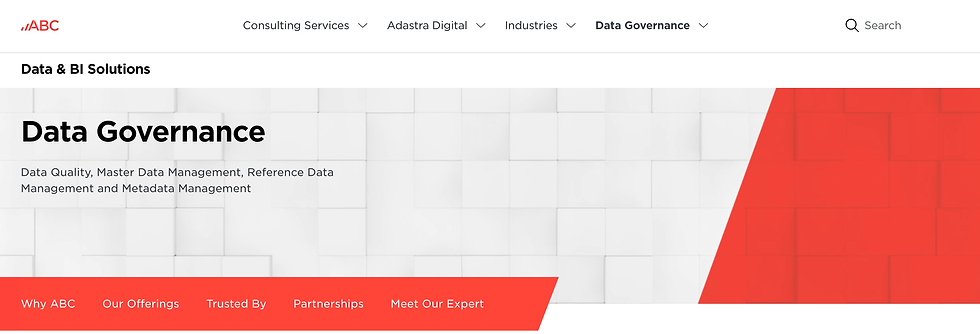
3. Adastra


Adastra data governance framework for people, processes, platforms and policies.
Adastra’s published governance approach considers processes, people, platforms and policies.

Adastra presents governance as a combination of processes, people, platforms and policies. This is a useful distinction because healthcare governance cannot be solved through software alone.


A clinic group may have technically secure systems but still experience risk when staff share passwords, export unnecessary spreadsheets or retain records without a defined purpose. A framework that addresses behaviour, ownership and change management may help prevent governance from becoming a document that nobody follows.


Adastra may therefore suit organisations building a formal operating model across several departments or locations. Prospective clients should ask for healthcare case studies and clarification about the frameworks, software and subcontractors that would be used.


Potential fit: Enterprises establishing a governance structure across multiple teams.


Ask before appointing: How will you ensure the operating model is adopted by clinical and administrative staff?


4. Kanerika


Microsoft Purview data discovery and governance services from Kanerika.

Image source:
Kanerika provides governance and information-protection services involving Microsoft Purview

Kanerika is particularly relevant to organisations already invested in Microsoft technology. Its services describe the use of Microsoft Purview to discover, classify and govern sensitive information across cloud, on-premises and software-as-a-service environments.


This may be useful for a healthcare organisation whose documents, email, collaboration tools and analytics already operate within Microsoft 365 or Azure. A central view of sensitive information can support classification, retention and access-control work.


Technology fit remains important. An organisation should not select Purview merely because it already uses Microsoft Office. The decision should account for data sources, licensing, implementation costs, staff capability and whether the platform can cover non-Microsoft clinical systems.


Potential fit: Microsoft-centred organisations seeking governance and sensitive-data discovery.


Ask before appointing: Which of our systems can Purview govern directly, and where would

manual controls still be required?


5. Ciklum


Ciklum data engineering and governance services for digital platforms.
Ciklum approaches governance in connection with product engineering, analytics and AI readiness.

Ciklum may be more relevant to digital health platforms and healthcare software businesses than to a small independent clinic. Its public materials connect data governance with product engineering, analytics, compliance and AI-enabled systems.


Building governance into a product during development can be more effective than adding privacy and access controls after launch. For example, a digital health application can incorporate role-based access, audit logs, retention settings and patient-permission controls within its original architecture.


Prospective clients should determine whether Ciklum would provide a dedicated governance engagement or incorporate governance into a broader product-development programme.


Potential fit: Digital health businesses building or modernising data-intensive products.


Ask before appointing: How will governance requirements be converted into testable product and engineering controls?


Questions to Ask Before Appointing a Consultant


Ask potential providers to answer these questions in writing:


  • Have you completed comparable healthcare or wellness projects?

  • Which laws, professional standards and industry requirements will you assess?

  • Who will provide legal or regulatory interpretation?

  • Will you identify whether a Data Protection Impact Assessment is required?

  • How will you map our existing systems and information flows?

  • Can you assess booking, payment, telehealth, marketing and clinical-record systems?

  • How will patient access and correction requests be handled?

  • How do you evaluate international data transfers?

  • Will you review processor contracts and subcontractors?

  • How will you separate clinical, administrative and marketing information?

  • What governance controls will apply to AI tools?

  • How will success be measured?

  • What documentation and training will we receive?

  • What support is available after implementation?

  • How will our information be returned or deleted when the engagement ends?


Do not rely only on claims such as “GDPR compliant” or “HIPAA ready.” Ask what those statements mean in relation to your organisation, systems and responsibilities.


Myth vs Fact


Myth: Moving patient records into the cloud transfers responsibility to the technology provider.

Fact: Cloud providers may have contractual and technical responsibilities, but the healthcare organisation must still understand its role, select appropriate processors and demonstrate accountable data handling.


Myth: Consent is always the correct legal basis for using health information.

Fact: The appropriate basis depends on the purpose and jurisdiction. UK organisations processing special-category information generally need both an Article 6 lawful basis and an applicable Article 9 condition.


Myth: Data governance is necessary only for hospitals.

Fact: Independent clinics and wellness providers may also hold sensitive information about pain, pregnancy, fertility, mental health, medication and treatment.


A Practical Starting Plan for Smaller Clinics


An independent clinic may not need an enterprise consultancy immediately. A focused review can begin with the following steps:


  1. List every system containing patient or client information.

  2. Record what information each system holds.

  3. Identify the purpose and applicable legal basis.

  4. Document which employees and contractors can access it.

  5. Remove unnecessary accounts and permissions.

  6. Review privacy notices and processor agreements.

  7. Establish retention and secure-deletion rules.

  8. Separate clinical communication from promotional marketing.

  9. Create a process for patient information requests.

  10. Document what staff should do if information is lost, misdirected or accessed improperly.


Organisations accessing NHS patient data or systems should also determine whether they must complete the NHS Data Security and Protection Toolkit. The toolkit allows organisations to assess their performance against the National Data Guardian’s data-security standards.


Frequently Asked Questions


What is healthcare data governance?


Healthcare data governance is the framework used to control how patient, clinical and administrative information is collected, accessed, corrected, shared, retained and deleted.


Is data governance the same as cybersecurity?


No. Cybersecurity protects systems and information against threats such as unauthorised access, malware and data theft. Governance determines ownership, purposes, quality, access, retention and accountability. The two disciplines overlap but are not interchangeable.


Does a small wellness clinic need data governance?


Yes, although the programme should be proportionate to its size and risk. A small clinic may begin with a data inventory, access review, retention schedule and incident-response procedure rather than an enterprise platform.


Can a consultant make a clinic GDPR compliant?


A consultant can help identify gaps and implement controls, but should not promise guaranteed compliance. The organisation remains responsible for understanding and demonstrating how it handles personal information.


What information should never be entered into an unapproved AI tool?


Staff should not enter identifiable patient information, treatment notes, symptoms, medical histories or confidential communications into an AI platform unless the organisation has approved the purpose, provider, contract and necessary safeguards.


How often should governance controls be reviewed?


Review them at planned intervals and whenever the organisation introduces new software, begins using AI, changes service providers, opens another location or experiences a security incident.


Conclusion


The right data governance consultant should do more than write policies or install software. The provider should understand how information moves through the organisation, where patients may be exposed to risk and how governance controls will operate during ordinary work.


N-iX may suit organisations combining governance with large data and cloud programmes. ScienceSoft may be relevant to complex data-management and modernisation work.

Adastra offers a framework spanning people, processes, platforms and policies. Kanerika has a strong Microsoft Purview focus, while Ciklum may appeal to digital health businesses building governance into software products.


These differences matter more than a simple league table. Healthcare organisations should begin with their own systems, risks and regulatory responsibilities, then choose a provider whose experience matches those needs.


For further guidance on privacy, AI, telehealth and health technology, continue exploring the A to Zen Therapies Digital Healthcare Hub and Patient Rights and Healthcare Support Hub.


References


Recent Posts

About the Author​


Monica Pineider is the author of the A to Zen Therapies health blog and founder of a Central London wellness clinic. She specialises in massage therapy and holistic treatments, drawing on professional experience since 2009 in reflexology, shiatsu, and deep tissue massage.


She trained in Thailand and Bali in traditional massage techniques before continuing advanced hands-on study in London across multiple therapy disciplines. This international and clinical background has shaped the approach and philosophy of A to Zen Therapies.


Monica oversees the editorial direction of every article published on the blog, including content written or contributed to by external specialists in areas beyond the clinic’s direct clinical experience. All content is reviewed to ensure clarity, accuracy, and alignment with our editorial standards.


She shares practical, experience-based insights to support relaxation, recovery, and everyday wellbeing.

​

​

⚠️ Medical Disclaimer


The information provided on this website is for educational and informational purposes only and is not intended as medical advice, diagnosis, or treatment.


Always seek the advice of your physician, qualified healthcare provider, or other licensed medical professional regarding any medical condition, symptoms, or treatment options. Do not disregard professional medical advice or delay seeking it because of information you have read on this website.


A to Zen Therapies and its contributors provide information for general informational purposes only and may not reflect individual medical circumstances. Individual results from wellness practices, supplements, or natural therapies may vary.


If you are pregnant, nursing, taking medication, or have a pre-existing health condition, consult a qualified healthcare professional before starting any new wellness routine, supplement, or therapy.


Use of this website and its content is at your own risk.

​

​

Editorial Note

​

This article has been reviewed in accordance with A to Zen Therapies’ Editorial Policy to ensure accuracy, clarity, and responsible, experience-based wellness information.

bottom of page